Showing posts with label Persija Jakarta. Show all posts

Saturday, October 11, 2014

2014 Indonesia Super League - Disciplinary Record and (Unofficial) Fair Play Award

source: ligaindonesia.co.id
The 2014 Indonesia Super League (ISL) qualifying round was finished on September 5. Starting October, the competition continues for the Last 8 phase up until the grand final on November.

The qualifying round, however, has left several notes on the record book. Based on official tally, from 220 matches (110 from each West and East zones), there are 597 goals (304 West, 293 East) scored in which 7 of them were own goals (4 West, 3 East) and 76 of them were scored from the penalty’s spot (41 West, 35 East). Also, the season recorded 1,546,674 attendance (1,124,574 West, 422,100 East) with 7,030 in average.

In terms of disciplinary, the 220 matches from both Zones have produced 841 yellow cards (413 West, 428 East), and 22 red cards (15 West, 7 East). In average, there are 3.8 yellow cards per match, and 1 red card in every 10 matches.


Speaking of disciplinary, the Indonesian Football Association (PSSI) have also imposed several sanctions and fines on clubs for violations done by their players and personnel. Sanctions and fines were also given for negative behaviors caused by supporters in a match. Also, based on the regulation, when a team receives 5 or more bookings in a match, the team will be fined as well. Here’s the list of sanctions and fines imposed by the Indonesian FA’s (PSSI) Disciplinary Committee in the 2014 ISL (From February to August 2014):


Flare burning, major cause of fines
source: bolaindo.com


The sanctions and fines were imposed for several reasons, mostly unsportmanship behavior from players and flare burning and throwing of object into the pitch by supporters.


This season, the Disciplinary Committee is more active on imposing sanctions and fines. In total, they have imposed fine of IDR 2,400,000,000 on ISL clubs throughout the qualifying round of the season, and that doesn’t include fines on clubs in Divisi Utama. It is good to make the perpetrators learn some lessons and behave themselves, but that sum of money should also be used to improve the quality of referees and their linesmen. Many questionable decision made by the refs and/or the linesmen still occurred in the 2014 ISL. The point is: sanctions and fines should not be imposed on players and club’s personnel only, but also on referees and linesmen who made questionable decisions way too often. Because, it is quite obvious that some –though not always- unsportmanship behavior done by players and club personnel were caused by those unfair decisions.

Still, many questionable decisions made by ISL referees and linesmen this season
source: indopos.co.id
Persib had to pay the most amount of fines this season. There was half billion rupiah of total fine imposed on their name. Rumor had it that the Disciplinary Committee were being very harsh towards Persib because Maung Bandung is one of the club with deep pocket. That, actually, can be confirmed as the second club with the most amount of fines is Arema, with IDR 310,000,000 in total. It seemed that the Disciplinary Committee put rich clubs under a microscope and imposing expensive fines easily.
Total amount of fines per club
click on image to enlarge
Hinca Panjaitan, Head of Disciplinary Committee
source: sundul.com
Persib’s short-fused Ferdinand Sinaga got the most fined player this season. He likes to be an outlaw as he likes to score goals. For his “misdemeanors”, he had to pay IDR 100,000,000 in total. An inside source said that the U-23 players made a joke about it, saying that Sinaga “opened a tab at the Disciplinary Committee and made a routine deposit.”
Ferdinand Sinaga, opened a tab and made routine deposit to the Disciplinary Committee
source: bola.okezone.com
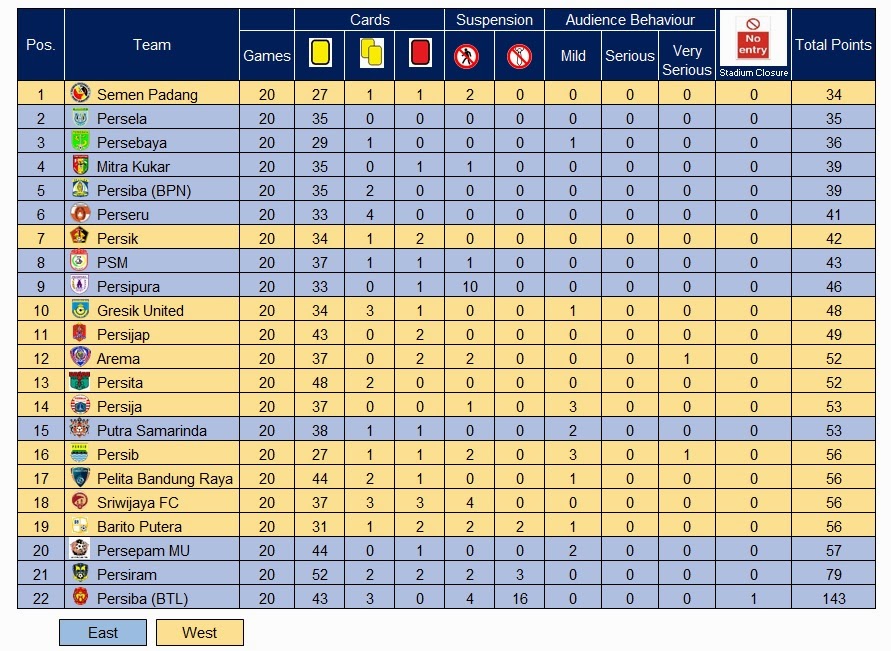
Because the league nor the federation has no system on determining Fair Play Award, I’ve made my version of Fair Play table of 2014 ISL using the same system as La Liga. Here it is:
2014 ISL Disciplinary Table
click on image to enlarge
Point system:
yellow card = 1 point/yellow card
2nd yellow card = 2 points/2nd yellow card
direct red card = 3 points/red card
games of suspension (player) = as many as banned games
games of suspension (club's personnel) = 5 points/banned games
audience behaviour = determined by amount of fine
- IDR 0 - 100,000,000 = mild
- IDR 100,000,000 - 200,000,000 = serious
- > IDR 200,000,000 = very serious
closure of stadium = 10 points/closure of stadium
*when serious incidents happen which are punished by the closure of stadium

Persiram players collected more bookings than any other 2014 ISL contestants. There are 54 yellow cards and 2 red cards given to Persiram players. However, Persiram’s disciplinary point collection is still fewer than Persiba Bantul’s. The fact that one of Persiba (BTL)’s personnel got banned for the whole season, as well as 1 closure of stadium have worsened their relegation. Lastly, congratulations to Semen Padang as the most behaved team in the qualifying round of the 2014 ISL.

Semen Padang, most behaved team in 2014 ISL
qualifying round

source: fcsemenpadang.com

Persiram, collected more bookings than any
other 2014 ISL contestants
source: goal.co.id
Sources:
Disciplinary Committee Release, February 12 
Disciplinary Committee Release, February 19 
Disciplinary Committee Release, February 27 
Disciplinary Committee Release, April 21 
Disciplinary Committee Release, 8 May 
Disciplinary Committee Release, 12, 22, 31 May 
Disciplinary Committee Release, June 12 
Disciplinary Committee Release, July 10 
Appeal Committee Release, July 11 
Disciplinary Committee Release, August 6 
Disiciplinary Committee Release, 14, 21, 26 August 
Sanction for Syakir Sulaiman  

Card data sourced and processed from ligaindonesia.co.id and cross-referenced with goal.com

Friday, October 3, 2014

2014 Indonesia Super League - Persija Stats


Pre-Preparation
After a disappointing campaign in 2013, Persija made a couple of head-start moves for the 2014 season. For example, even before the year 2013 was over, Persija was the first team among other 2014 Indonesia Super League (ISL) contestants who launched their official jersey. Also, still in 2013, Persija started their preparation program ahead of any other teams by holding and participating in the 2013 Trofeo Persija. They invited Arema, Army United FC (Thaliand) and PDRM FA (Malaysia) to the mini-competition. The Kemayoran Tigers managed to win twice against the foreign invitees (2-1 vs PDRM FA, 4-1 vs Army United), but those weren’t enough to stop Arema from winning the title. Collecting the same number of points as Persija, The Crazy Lions claimed the first spot on goal productivity. It was the first Trofeo Persija won by a team other than Persija.


2014 Trofeo Persija Logo
source: sidomi.com
Along came 2014, Persija participated in the 2014 Inter Island Cup (IIC) held by Liga Indonesia. A traditional pre-season competition as a warm up before the season starts. But just like in previous editions, Persija failed to proceed from the qualification phase. Only got 2 points from 3 matches put Persija behind Arema and Persela in Java – Group 2. The result concluded Persija’s preparation before the 2014 ISL curtain raiser.

Squad

The departure of the prolific striker Emmanuel Kenmogne left a huge hole in Persija’s arsenal. For over 2 months, Persija tried to find the replacement. First, they invited Shaka Bangura for trial during the 2013 Trofeo Persija. The Sierra Leonean failed to impress Benny Dollo and got dumped right after. Then, they put the Argentine Mario Costas (former Persela) on trial for the 2014 IIC. He scored 2 goals in the campaign, but the coaching staff saw no improvement in weeks prior to the start of the competition. Suddenly, the management announced that they have secured the service of a former FIFA World Cup participant from Croatia. It was Ivan Bosnjak who got the honor to join the squad. The former DPMM (Brunei Darussalam) striker also got to wear the no. 10 jersey.

Ivan Bosnjak, former Croatian international who played in the 2006 FIFA World Cup
as Persija's big signing for the 2014 ISL
source: bolaindo.com
As the new foreign players’ composition rule put in effect in the 2014 season, Persija used the maximum quota of 4 foreigners in their squad the whole season. After updating Fabiano da Rosa Beltrame and Rohit Chand’s contracts, as well as securing Bosnjak’s role, the management signed Bosnian Zelimir Terkes to accompany Bosnjak upfront.

As for the locals, Benny Dollo’s tendency to trust young players made the squad filled with youngsters. Names from the previous season like Dany Saputra, Andritany Ardhiyasa, Syahrizal, A. A. Ngurah Wahyu, Ismed Sofyan, Amarzukih and Defri Riski filled the squad’s list along with familiar new recruits of Egi Melgiansyah, Victor Pae, and Agung Supriyanto. Rizky Ramdhani Lestaluhu is also among those names, following a not-so-good season with Sriwijaya FC. April Hadi also joined the nation’s capital club from PSPS.

As the first half of the season finished, a couple of changes were made. Very poor performance from Zelimir Terkes put the Bosnian on the outgoing box. His last ever match for Persija was in a friendly against Ajax Amsterdam on May. He left Jakarta with 0 goals and only 4 appearances throughout the season (2 in ISL and 2 in friendlies). To replace him, the management invited Habib Bamogo for a taste in the friendly against Ajax, but the Burkinabé’s unfit posture dissatisfied the coaching staff. Luckily for Persija, Persipura surprisingly released Boakay Eddie Foday from their squad just after the Liberian scored 5 goals for the Papuan team in the 2014 AFC Cup campaign. Without further ado, Foday was given the no. 25 orange jersey of Persija.


Poor performance was also the reason behind Rudi Setiawan’s loan release to Martapura FC.

Ponaryo Astaman returned to Persija
source: persija.co.id

2 other additions to the squad made in the 2nd transfer window involving Agus Salim from Persipasi and ex-captain of the Indonesian National Team Ponaryo Astaman from PSM. Salim was Persipasi’s top scorer at the time before he moved to Jakarta.

The media flown over a gossip that said “Ex-Persija is about to return to Jakarta.” Of course, the first name came out on the fans’ minds was Bambang Pamungkas. But it turned out to be Ponaryo Astaman. The deal was made hours before the 2nd transfer window was closed.


Campaign 
Please follow this link to visit Persija's 2014 ISL season results
 
1st phase
Persija started the season with a rare away win over Barito Putera at Demang Lehman Stadium. Rohit Chand scored Persija’s first goal of the season only 3 minutes after the kick-off. Ramdhani Lestaluhu secured Persija’s first 3-point with a late 83rd-minute goal.

On their first home game of the season, they beat Semen Padang 2-0 in front of 23,000+ crowd of Gelora Bung Karno (GBK) Main Stadium. Bosnjak scored his first goal for Persija from the spot, while Rachmat Affandi’s header ensured Persija’s 1st home win.

Their next fixture was a tricky one: away to Bandung against Pelita Bandung Raya (PBR), where their former icon Bambang Pamungkas plays. For the 1st and 2nd time on the history of his career, BePe scored 2 goals to Persija’s net in that fixture. However, Persija struck back and equalized with Bosnjak’s penalty and April Hadi’s header.
They supposed to face Persib on February 22, but due to no permit issued by the authorities, the match was postponed to May 8. Until that date, Persija went through 3 wins (1-0 vs Persita (H), 2-0 vs Persijap (A), 1-0 vs Gresik United (H)), 1 draw (1-1 vs Sriwijaya FC (H)) and 2 defeats (1-2 vs Persik (A), 0-1 vs Arema (H)). Along came May 8, Persija brought home a point from Bandung after a scoreless draw against Persib. The match was enlivened by bottle throwing and intimidation towards Persija players. Those results put Persija on the 3rd spot of the West Conference table at the half-season break.
Team huddle before kick-off
source: persija.co.id
2nd phase
0-1 defeat in Malang and 1-1 draw against Gresik in the first 2 matches of the 2nd phase pulled Persija down to the 4th spot of the table. They strived back with a double win at home, 4-1 against Persijap and 1-0 against Persik. Their trip to Palembang resulted in a 1-3 defeat against Sriwijaya FC. Before the 2-month break due to series of local and international events, Persija recorded their biggest win of the season over Persita with a 4-0 away win. At this point, Persija was still on the 4th position.

Right after the break, Persija hosted Persib in front of a capacity crowd of 66,000+ at GBK. The number became the 2nd highest attendance record in the history of ISL, right under full house crowd of 85,000 in 2010 when Persija hosted Arema at the same place. Unfortunately, the match couldn’t keep up with the atmosphere of the stadium and ended scoreless.

Next up, another visitor from Bandung who also brought Persija’s goal scoring record holder, PBR. A win would have put Persija on the driver’s seat towards the last 8. Sadly, Bambang Pamungkas had a different idea and agenda. His masterpiece header strike almost put Persija in misery on their spot, before a very late controversial penalty from Ponaryo Astaman saved the home side from humiliation. Nonetheless, the result turned out to be very decisive and determined Persija’s outcome of the season.
Bambang Pamungkas, 3 goals in 2 matches against Persija
source: bolanasional.co.id
Next match away to Padang against Semen Padang was considered as the decider of whether Persija would qualify to the last 8 or finish the season earlier. A scoreless draw in H. Agus Salim Stadium followed by a double win by PBR at the end of August kicked Persija out from the top 4.

On the last day of the regular season (9/5) an unsurprisingly odd fixtures set up by the league operator, PT. Liga Indonesia. Instead of playing all 10 games at the same time, they decided to separate the kick-off times, including those involving Persija and PBR. Persija had to wish that PBR would drop a point or two in Karawang against Persita, while hoping for the best to beat Barito Putera in GBK. But there was no drama on the stage. PBR who player as early as 15:30 ensured the 4th spot for themselves by winning 3-1 against Persita. To put insult to injury towards Persija, two ex-Jakartans scored the goals for PBR (BePe and T. A. Mushafry). Thus making Persija’s last match against Barito Putera at 19:00 had no importance other than a formality. A 3-1 victory over the visitor from Banjarmasin meant nothing, as the fans were yelling for the management to step down. That concludes another disappointing season for the Kemayoran Tigers.

At the end of the season, Persija sat on the 5th position with 34 points from 9 wins, 7 draws, and 4 losses. They scored 27 and conceded 15 goals throughout the season, with 9 clean sheets on their name. Persija is one of the team with no player sent off in the 2014 ISL, along with Persela. The immediate outcome from the campaign is that Benny Dollo will no longer stay at the club for the 2015 season.


Players and officials giving salute and appreciation to the fans
source: tribunnews.com

Player Stats


6 Persija strikers in the 2014 ISL only scored 9 goals in total (Ivan Bosnjak 4, Rachmat Affandi 2, Boakay Eddie Foday 2, Agung Supriyanto 1). The midfielders contributed more goals with Rizky Ramdhani Lestaluhu came up as Persija's top scorer of the season with 8 goals. Other midfielders who scored are Victor Pae (3), April Hadi (1), Ponaryo Astaman (1), and Rohit Chand (1). Captain Fabiano da Rosa Beltrame scored 3 header goals, and 1 goal came from A. A. Ngurah Wahyu Trisnajaya.

Rizky Ramdhani Lestaluhu, Persija's top scorer in the 2014 ISL with 8 goals
source: sidomi.com
Fabiano and Andritany Ardhiyasa collected more appearances and playing minutes than any other Persija players this season. Each of them played 19 times for 1710 minutes in total throughout the season.
Andritany Ardhiyasa and Fabiano da Rosa Beltrame, 19 apperances, 1710 minutes each.
source: indopos.co.id and mediasepakbola.co.id
Fabiano and Victor Pae received most yellow cards for Persija this season. Each of them collected 5 yellow cards.
 
Table Movement

Persija's table movement on the 2014 ISL West Conference Classification
click on image to enlarge
 
Team Records
 
Attendance
Persija’s management in the 2014 season has shown quite of an improvement. One obvious example would be the sponsor’s logo on Persija’s jersey.

They also launched a new fans hospitality program called “Persija Card”, which can be used to book ticket, on-line. As far as I’m concerned, they’re the first Indonesian club who does that. The impact was very significant. Persija recorded highest attendance record of the season with 258,051 in total from 10 matches held in GBK (average 25,805). The number trails Persib’s as well as Arema’s with significant difference.


Persija's Home Attendance Record in the 2014 ISL
click on image to enlarge

TV Broadcast
The deal with pay-based television has brought quite a benefit for the 2014 ISL contestants. More matches being broadcasted live this season, and Persija made the most from it. All 20 matches in which Persija was involved were being broadcasted live. The record they shared with Persib and Arema.

Wednesday, May 14, 2014

2014 Indonesia Super League – Mid-Season Stats

The 6th edition of Indonesia Super League (ISL) has reached half-season.

There are some changes have been made to the league system this season. Instead of the usual single-zone full season system with 18 participating clubs, the 2014 ISL applies ‘old but new’ 2-zone system. Before the ISL era, the Indonesian League competition used the same system for several seasons. This year, there are 22 clubs (somewhat) geographically divided into West and East zones. Each zone consists of 11 clubs. Top 4 clubs from each zone will compete in another 2 groups of Big 8 consist of crossovers from both zones. Then it will come to an end with semi-finals and final(s).
 
There are also some improvements being made this season. One of them is regarding TV broadcast. Unlike past seasons, ANTv and TVOne are no longer in charge of broadcasting ISL matches. The responsibility was given to MNC Group for free-to-air broadcasts, and Kompas Media Group for pay-based broadcasts. That’s right, for the first time in the history of Indonesian football, one has to subscribe and pay some money to watch local competition on TV. To make it more interesting, most of the matches this season were being (and will be) broadcasted from the pay-based one!
 
Some problems still occur, though. Classic ones like late payment, players’ unsportsmanlike behavior, controversial decisions by the referee, etc., but at least there’s progress being made. It certainly takes time for people and for the league’s operator to get used to it.

source: ligaindonesia.co.id

Mid-Season Table
Table 1.1 - 2014 ISL Tables up to Mid-Season Break
click on image to enlarge
Not much of a surprise in West Zone as Arema leads comfortably with 7-point gap ahead of Persib. Arema is considerably the best team of the season, judging by points collected, as well as their goal scoring and defense records. Persijap, on the other hand, is having a problematic season as they are sprawled at the bottom with only 4 points. They did what Manchester United have done by sacking Raja Isa and appointed Evaldo Silva as player-manager.

Figure 1.1 - 2014 ISL West Zone Mid-Season Table Movement
click on image to enlarge
East Zone has more interesting progress. Mitra Kukar and Persela lost in their respective first matches, but they ended up on the top accordingly at half-season break. Defending champions Persipura took the 3rd spot. Still unbeaten but lost many points on draws. The top 4 of this zone have only 1 point separating each of them at mid-season break. At the bottom, Bantul’s Persiba currently minds the relegation door with only 5 points. The task to salvation would be much harder if they fail to unify their brawling supporters, which caused them the right to play at their traditional Sultan Agung Stadium for a couple of occasions.

Figure 1.2 - 2014 ISL East Zone Mid-Season Table Movement
click on image to enlarge

Goal Records
Each zones have played 55 matches up until mid-season break. From 110 matches in total, there are 287 goals scored, 144 from West and 143 from East. Each zones have 18 goals scored from the spot, making it 36 goals from penalty kick in total. Each zones also have 2 own goals, making it 4 in total. All items (West, East, Overall) have a good number of 2.6 goals/game average.

126 different players have scored, 67 players from West, 59 players from East.
43 local players from West have scored 79 goals, while 35 local players from East have scored 72 goals.
24 different foreign players from each zones have contributed on the score sheets. 63 goals came from West foreigners, while East foreigners netted 68 goals.
 
Emmanuel Kenmogne (Cameroon, Persebaya) tops the top scorer list with 9 goals, followed by Ilija Spasojevic (Montenegro, Putra Samarinda). Among the top list, only Samsul Arif (Arema) who is a local born with 6 goals.
Table 2.1 - 2014 ISL Top Scorers' List up to Mid-Season Break
Kenmogne also recorded consecutive goal scoring streak when he fired 6 goals in 4 consecutive matches. Djibril Coulibaly (Persib) also scored consecutively in 4 matches, but only netted 5 goals.

Emmanuel 'Pacho' Kenmogne, 2014 ISL Top Scorer at Mid-Season Break
source: beritajatim.com
Lukas Mandowen (Persipura) has made 2 records in terms of goal scoring this season. He scored the very first goal of the season against Persela. He also marked the fastest goal of the season when he scored against Persebaya, 19 seconds after kick-off. He could also put his name as the shortest player to score a header with that goal. Because he's only 156 cm tall!

Lukas Mandowen, Scored the First Goal of the 2014 ISL
source: ligaindonesia.co.id
Arema’s 26 goals put them as the most productive team of the half-season, followed by Persebaya with 19 goals. The Singo Edan also recorded 2 largest winning margin records when they bested Persik and Gresik United with 5 goals to nothing.

Persipura v Persiba Bantul clash produced 7 goals, more than any other matches, which Persipura won 5-2.


7 players have scored hat-trick up to half- season, and put themselves as co-holders of most goals scored by a player in a single match, namely: Emmanuel Kenmogne, Ilija Spasojevic (Putra Samarinda), Bijahil Chalwa and Srdan Lopicic (Persela), Boaz Solossa (Persipura), Samsul Arif and Herman Dzumafo Epandi (Mitra Kukar).


Attendance Records

Table 3.1 - 2014 ISL Attendance Records by Club up to Mid-Season Break
click on image to enlarge
Matches in the East Zone have attracted 262,130 (avg. 4,766) people. West Zone doubled the number up to 563,315 (avg. 10,242) and made it 825,445 (avg. 7,504) in total. Zonal gap in attendance is mostly caused by the fact that some clubs in the East zone have to play their home matches away from home. PSM, Persiram, and Perseru have to wander to East Java because their stadiums did not meet the requirements. Attendance on their wandering matches have never reached 1,000. Also, as mentioned before, Persiba Bantul had to play 2 home matches at an Air Force Academy’s field, where only few people bothered to come.

Persija, quite surprisingly, surpassed usual crowd-attractors Persib and Arema this half-season. From 5 home matches, Persija got 114,131 (avg. 22,826) attendance record, about 3,000+ more than Persib’s 110,743 (avg. 22,149). Meanwhile, Arema failed to reach 100,000+ attendance record albeit their positive performance. Only 76,871 (avg. 15,374) people occupied the Kanjuruhan Stadium in their first 5 home matches.


Persija v Arema match at Gelora Bung Karno Main Stadium on May 4 recorded most attendance with 39,880.


JakManias at Gelora Bung Karno Stadium
source: agent108.biz


Disciplinary Records
Yellow Cards

Table 4.1 - 2014 ISL Yellow Card Recapitulation by Club and Players' Status
up to Mid-Season Break
click on image to enlarge
There were 422 yellow cards pulled out from the referees’ pocket from 110 matches in total (avg. 3.79 yellow card/ match).

In West Zone, 198 yellow cards
(avg. 3.6) were awarded to 119 different players, 95 locals and 24 foreigners. Those 95 local players received 156 yellow cards, and the 24 foreigners got 42 bookings. 6 players from this zone have received 4 yellow cards by their names only, namely: Hariono and Tantan (Persib), Fatkhul Manan (Persijap), Lucky Wahyu (Barito Putera), Vendry Mofu (Sriwijaya FC), and Gusripen Effendi (Persita).

East zone’s yellow card record is worse than the West. 224 yellow cards
(avg. 4.07) were given to 132 different players, 109 locals and 27 foreigners. 173 yellow cards were given to the locals, while 51 were for foreigners. Last season’s most yellow card record co-holder Elvis Herawan (Persiram) faces a serious rival this season. While Elvis only got 4 yellow cards, Tony Roy Ayomi (Perseru) already collected 5, more than any other players.

Tony Roy Ayomi, 5 Yellow Cards Already
source: majalahselangkah.com
Gerald Pangkali (Persipura) received the first yellow card this season on the curtain raiser match against Persela.

Persita v Persijap and Persela v Persiram matches recorded most booking in a single match. Both matches have 9 players booked.


Red Cards
Table 4.2 - 2014 ISL Red Card Recapitulation by Club and Players' Status
up to Mid-Season Break
click on image to enlarge
Up until half-season break, there are 24 expulsions (avg. 0.22 red card/ match) made by the referee. West Zone recorded 15 red cards (avg. 0.27), while East Zone has 9 (avg. 0.22).

9 red cards for locals and 6 for foreigners in the West Zone, all awarded to different players. East zone recorded sending offs of 7 locals and 2 foreigners.


Each of Gresik United, Sriwijaya FC, and Persiram have 3 red cards, more than any other teams this half-season.

Sriwijaya FC got 2 of their players sent off (Ahmad Sumardi and Vali Kenari) on a 1-5 thrashing against Persik. While Gresik United received 3 red cards in 3 consecutive matches (Jimmy Suparno, vs Pelita Bandung Raya (4/23); Shohei Matsunaga vs Persija (4/29); and Otavio Dutra vs Semen Padang (5/3)).


The first red card of the season was given to Hariono, when Persib faced Persita.


Clean Sheet Records
Table 5.1 - 2014 ISL Clean Sheet Record up to Mid-Season Break
click on image to enlarge
Only 4 players managed to score against Arema up to half-season. Ahmad Noviandani (Persijap) beat Kurnia Meiga for the first time for a consolation goal, while Persib’s Coulibaly Djibril, Firman Utina, and Konate Makan brought Singo Edan down with a remarkable comeback. Arema went through the other 8 matches without conceding any goals.

Persik and Persiba Bantul are the only 2 teams with no clean sheet record this half-season.


 ***
the author gathered and processed all data on this post from ligaindonesia.co.id

Tuesday, May 6, 2014

A Simple Guide to Enjoy Football at the Gelora Bung Karno Main Stadium

Hello!

Greetings from Jakarta!

So, are you a traveler who’d like to have a football experience in the capital of Indonesia? Well, you come to the right place!

As a football enthusiast who was born and raised in Jakarta, I’d like to share some information on how to enjoy football here in my hometown, especially at the Gelora Bung Karno (GBK) Main Stadium. My experience of watching dozens of football match in that stadium since the 90s is what motivates me to publish this blogpost.
 
At this point, we are still able to say that football is the most popular sport in Indonesia. The people here loves to watch it, play it (both actually and virtually), and talk about it. They admire international football (or sometimes we call it “football on screen”) as well as their own local football. Despite the fact that achievement is lacking from the Indonesia National Team and Indonesian clubs at international level, people of Indonesia still loves their football. For most of them, international football is only for their amusement, while local football is all about pride.
 
As the center of government and business activities of Indonesia, the city of Jakarta is filled with people who loves football as well. No matter how the world weighs on their shoulders, Jakartans are proud of their local clubs. Jakarta area has a couple of football clubs, namely: Persija, Persitara, Villa 2000, and Persikad. Not to mention clubs in Greater Jakarta areas, like Persita, Persikota, Persipasi and Persikabo. On every matchdays of the local competitions (the Indonesia Super League, Premier Division, and Division One), hundreds and even thousands of fans fill up the stadiums of the respective clubs.
 
Speaking of stadiums, Jakarta also has a couple of them. They are scattered in 5 municipalities (kotamadya) of Jakarta, but only some of them are eligible to host a national-level match. Those are Kamal Muara Stadium (North Jakarta), Lebak Bulus Stadium (South Jakarta), Ciracas Stadium (East Jakarta) and PTIK Stadium (South Jakarta). Lastly, there’s one international level stadium in Central Jakarta, the GBK Main Stadium.
 

Gelora Bung Karno Main Stadium
source: www.indonesia.travel

GBK is a sports complex opened in 1962 by Indonesia’s first president, Soekarno. ‘Gelora’ in GBK is an acronym of ‘gelanggang olah raga’ (Eng.: Sports Complex). The complex has many sports and leisure facilities such as Olympic size swimming pool, tennis courts, baseball field, basketball hall, football fields, and others. The main multi-purpose stadium is located at the heart of the complex.
 
The stadium underwent a renovation process starting 2005. After the renovation was finished in 2007, the seating capacity of the stadium was reduced from 120,800 to 88,000. The stadium has hosted several international football competitions such as the 2007 Asian Cup of Nations, 2002 and 2010 South East Asian Cup as well as 4 South East Asian Games (1979, 1987, 1997 and 2011). Occasionally (especially in a major tournament), the Indonesia National Team use the stadium for their home game. But the current and loyal tenant of the stadium is the biggest club in Jakarta: Persija.
 
That’s enough for an opener, and here are some tips for those who want to enjoy football at the GBK Main Stadium.

 
How to Get There?

The GBK Sports complex official address is Jalan Pintu Satu Senayan, Central Jakarta, 10270. Look for it using ‘Stadion Utama Gelora Bung Karno’ as keyword in your GPS. It is located near the House of Representatives and People’s Consultative Assembly’s building (MPR-DPR building).
a. Using Public Transportation
From the Airport
if you want to go straight to the stadium from the airport, whether if you come from Soekarno-Hatta International Airport (SHIA) or Halim Perdanakusumah Airport, taking a taxi would be the most efficient way. With the fare ranging from IDR 100,000 – 200,000 (depends on the taxi’s type and group, and excluding toll charges), just ask the driver to take you to GBK or ‘Stadion Senayan’. If the traffic’s fine, you’ll be there in less than an hour.

But be careful for unofficial taxis. Do not take any offer from anyone who offers you a car ride or taxi. Ask for information regarding taxi queuing lines to the staff the information center.

You can also use DAMRI shuttle bus service from SHIA using the Blok M line with IDR 30,000 (April 2014). You can purchase the ticket at DAMRI booths in each SHIA terminals. Take the bus and hop off at Senayan (ask the bus driver or his assistant to drop you off there). From the bus stop, it’s a 10-minute walk to the stadium. The shuttle bus will cost less money, but it will cost you more time as the bus service almost always off schedule.

Public Buses
If you’re in the city already, the easiest public transportation mode to get to GBK is using the TransJakarta Bus Service, Jakarta’s trademark bus line who has its own lane on the street, with only IDR 3,500 (April 2014). Make your way to Corridor 1 (Blok M – Kota) of the TransJakarta service line, and hop off at GBK shelter. From there, it’s about 5-minute walk to the stadium complex. Here’s the TransJakarta Service Network.

TransJakarta Bus
source: republika.co.id
There’s also a TransJakarta integrated bus service, the Kopaja S.13 (Ragunan – Grogol). The bus service is using the same hop-on method as TransJakarta, but it costs IDR 5,500 (April 2014). This bus service runs across shelters in Corridor 1 and Corridor 8 of the TransJakarta Service Network. The GBK shelter is one of them.

Actually there are standard-service buses that pass by GBK with the fare ranging from IDR 2,000 to 6,000 (April 2014). Standard-service buses are not very recommended, as their schedule and cozyness is not as good as TransJakarta’s. But, here’s just in case:

From Blok M Terminal: PPD PAC.801 (Blok M – Kota), PPD P.1 (Blok M – Kota), PPD P.45, Mayasari PAC.34 and AJA.138 (Blok M – Tangerang/ Cimone), PPD PAC.21 (Blok M – BSD Serpong), PPD P.53 (Blok M – Depok), Mayasari R.300 (Blok M – Rawamangun), Mayasari R. 921 (Blok M – Kampung Melayu), PPD P.36, PPD P.68, Mayasari P.13, Mayasari PAC.06 and Mayasari PAC.08 (Blok M – Pulo Gadung), Steady Safe P.134 (Blok M – Klender), PPD PAC.80 (Blok M – Kampung Rambutan), Mayasari P.27 and Mayasari 05 (Blok M – Bekasi Barat), Mayasari 121 (Blok M – Cikarang)

Pass by Blok M Terminal: Kopaja P.19 (Tanah Abang – Ragunan), Kopaja S.615 (Lebak Bulus – Tanah Abang)

From Lebak Bulus Terminal: Koantas 102 (Lebak Bulus – Tanah Abang), Kopaja P.13 (Lebak Bulus – Tanah Abang), Mayasari PAC.41 (Lebak Bulus – Kali Deres), PPD PAC.16 (Lebak Bulus – Rawamangun), PPD P.20 and PAC.12 (Lebak Bulus – Pulo Gadung)

Pass by Lebak Bulus Terminal: Bianglala P.69 (Kota – Cuiputat),

From Grogol Terminal: PPD PAC.802 (Grogol – Pasar Baru), Mayasari P.18A (Grogol – Pondok Labu), PPD 213 (Grogol – Kampung Melayu), PPD PAC.10A (Grogol – Kampung Rambutan)

From Kali Deres Terminal: Mayasari PAC.69 (Kali Deres – Blok M), Mayasari PAC.41 (Kali Deres – Lebak Bulus), Mayasari PAC.50 (Kali Deres – Kampung Melayu).

Trains
Gambir, Jakarta Kota, Pulo Gadung, and Pasar Senen train stations are integrated with TransJakarta Service Network. Make your way to the nearest TransJakarta bus shelter if you stop at one of those train stations, and make your way to Corridor 1 as explained before.

If you come from Jakarta’s satellite cities such as Tangerang, Depok and Bogor, you can use the KRL CommuterLine train service. Fare ranging from IDR 6,000 – IDR 9,000 (depends on distance and including IDR 5,000 rental fee). Here's KRL CommuterLine's route.

Make your way to the Maja/ Parung Panjang/ Serpong – Tanah Abang (PP) route (highlighted in green), and hop off at Palmerah station. From there, it’s about 15-minute walk to the stadium complex, or you can use the motorcycle taxi (Ojek) from the station, with the reasonable fare of IDR 10,000 – IDR 15,000.
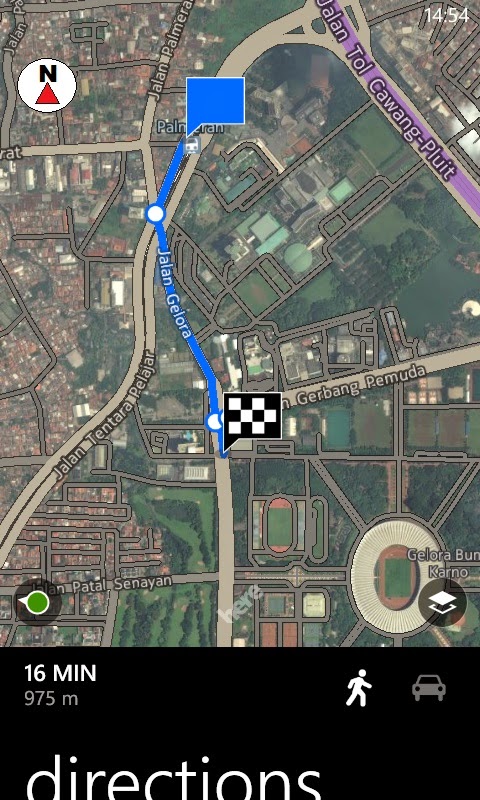
Distance from Palmerah Station to GBK Complex
click on image to enlarge


If you decide to use public transportation, please consider Jakarta’s rush hour to your travel time for the sake of your convenience and punctuality. At 07.00 – 09.00 and 16.00 – 19.30, the public transportation and road system will be on their peak workloads. Packed buses and trains and traffic congestions are most likely unavoidable.

Football match in Indonesia usually starts at 15.30 or after 19.00. So, I suggest you to be around the stadium before the rush hour starts.


b. Using Your Own Vehicle
Based on my experience, the most efficient vehicle to go to GBK during a matchday is motorcycle. Its ability to slip through cars during traffic and alleys to cut corners makes it reliable during rush hour. But it’s not comfortable enough, especially during adverse weather. Also, you can only take 1 person to accompany you.

However, always obey the regulations if you want to go to the stadium by motorcycle. Wear standard helmet and turn on the headlight even if it’s during the day.

If you decide to take your car, be advised of the rush hour.

Parking 
You can actually park your vehicle in the GBK complex. There’s a lot of parking spots for cars and motorcycles. But be advised, those parking spots are swarmed with unofficial parking officer. To enter GBK complex, there’s an entrance fee of IDR 3,000 for motorcycle and IDR 5,000 for car (April 2014). Those fees include parking fare, but if you park your vehicle in one of those parking spots, the “officer” there will ask you to pay more, up to an unreasonable fee (especially for cars).

I suggest you to park your vehicle in one of the buildings surrounding the GBK complex. You can go to either Plaza Senayan, f(X), TVRI office, or Department of Education and Culture (DepDikBud) to park your vehicle. It’s about 5 to 10 minute walk from those places to the stadium.

Parking outside the stadium complex avoids you from pre-match crowd. Also, it provides more security to your vehicle, although it costs you more.

After the match has ended, the post-match crowd is inevitable. For those who use public transportation, get ready to face packed vehicles. Just be patience and enjoy the ride home.


Match Tickets


Ticket price for matches at GBK main stadium is varied based on seating class. Each seating class has a varied price as well, depends on the occasion. When the match is a “much anticipated” like finals of a tournament or an exhibition match against foreign big names, the price shall be high. Otherwise, at a “less anticipated” matches, the price is on low. For the routine Persija match of the 2014 Indonesia Super League, the price is ranging from IDR 30,000 to IDR 200,000.
 
The cheapest one is the upper stands ticket, or usually categorized as ‘Category III’. Ticket for this class has price ranging from IDR 25,000 to IDR 75,000.
 
Next, there’s the ‘Category II’ class. It is on the lower stands behind the goals. Price for this class is ranging from IDR 40,000 to IDR 100,000.
 
Then there’s ‘Category I’ class. Sometimes it’s called ‘Kelas Satu’ (Eng.: First Class). Stands for this class are located behind of each corner flags. The price is ranging from IDR 60,000 to IDR 250,000.
 
Following the first three classes, is the East VIP class which is located on the East side of the lower stands, with price ranging from IDR 100,000 to IDR 350,000. After that, there’s West VIP on the West side of the lower stands, with price ranging from IDR 150,000 to IDR 1,000,000. Lastly, there’s the VVIP and the Royal Box, the deluxe classes. You have to prepare around IDR 200,000 to IDR 1,500,000.
 

GBK Seat Layout (from the 2010 AFF Suzuki Cup)
source: thecrowdvoice.com
When the euphoria is through the roof, match tickets are really hard to find and to get, regardless the price. So, I suggest that you have secured your ticket before the matchday for your own convenience. Nowadays, the match officials collaborate with ticketing companies and launch online ticket sale or pre-sale ticket in ticket boxes. You can search the internet for information regarding tickets of a particular match held in GBK days before the matchday.
 
For pre-sale and online pre-sale, sometimes, you have to exchange the receipt with the ticket first, in a certain location on the matchday. It’s not quite practical, but it beats the time to wait in line or finding the fact that the tickets are already sold out.
 
But if you have no choice but to buy ticket on the matchday, you can go to one of the ticket booths around the GBK complex   

a. Ticket Booths
Ticket Booths in GBK complex
click on image to enlarge
There are 6 ticket booth spots in GBK complex. Not all of them are functioning on a regular basis, but during the nationwide football euphoria, all of them shall be opened, especially for high-rated matches involving the Indonesia National Team. Here they are:
  1. Al-Bina booth, located on the South side of the complex, next to Al-Bina Mosque. Open regularly on matchdays. Has 4 counters. 
  2. East Parking Area booth, located on the East side of the complex, in front of ISTORA building. Open regularly on matchdays. Has 8 counters.
  3. Basketball Hall booth, located on the Northwest side of the complex, right next to the Basketball Hall. Open regularly on matchdays. On Persija’s matchdays, the booth is dedicated to sell tickets for Persija supporters (JakMania) only. Has 4 counters.
  4. North Plaza booth, located on the North side of the complex, right at the gate of North Plaza. Not open regularly on matchdays. Has 8 counters, 4 on each left and right gates.
  5. KONI Street Side booth, located on the Southwest outside of the complex, on the street side in front of KONI building complex’s entrance. Open quite regularly on matchdays. Has 4 counters.
  6. West Plaza booth, located on the West side of the complex, on the right side of the West Plaza entrance. Not open regularly during matchdays. Has 8 counters.
    Additionally, during Persija’s matchdays, you can buy the VIP and VVIP tickets only at a table counter located in the West VIP and VVIP entrance. Look for a huge Archer’s statue on the West side of the stadium. The table is facing its rear.
Locations of GBK Ticket Booths on the Map
click on image to enlarge
Be advised that during every matchdays, there are a lot of ticket scalpers swarming around the stadium (especially on the stadium’s ring road). DO NOT BUY TICKET FROM THEM. As you will have to pay a lot more than the official price and also the high-risk of you getting a counterfeited ticket. Besides, it is very bad for the industry.


At the Stadium
 
So, you got the ticket and you are at the stadium already, but you still have to wait for your friends so that you can enter the stadium together? In that situation, you need the right meeting point to avoid confusion. Be advised that once the stadium and the stadium’s ring road got very crowded, communication using cellphone is going to be quite difficult.
 

There are several places in the complex that you can easily spot as meeting point. The most common spot is the Archer’s statue at the West VIP & VVIP entrance.

Local Guy standing under the Archer's Statue at the West VVIP Entrance
But you might want to check your ticket first for the entrance that leads to your seat at the stands. You can adjust your meeting point that closer to said entrance.
 
Entrance to the Stands
Pay attention to the entrance’s layout. GBK Main Stadium has 36 ‘Pintu(Eng.lit.: Door) that round clockwise the stadium. These Pintus has 2 different numerals to distinguish upper and lower stands.
 
There are 24 Pintus for the upper stands that use Latin numbers, e.g.: PINTU 1, PINTU 17, PINTU 22. Written in the sign is 'PINTU TRIBUN ATAS' followed by the number.

Lower stands’ pintus are written in Roman numerals and there are 12 of them, e.g.: PINTU I, PINTU III, PINTU XI, etc. You can easily locate the signs as it is clearly put on top of each doors with large writing. Follow the number of Pintu written on your ticket to enter. Usually, the layout of the Pintus is printed on the ticket.

Security Checkpoint
Before you enter the stands, as always, there will be a security check. The officers who are responsible to do body check usually biased. Sometimes, they’ll thoroughly search your belongings and body for prohibited materials, but quite often that they just simply let you in upon gazing your appearance. Let’s say that some of the officers use stereotypical technique.
 

Do not bring prohibited materials by any means. No flares, sharp objects, explosives, drugs, etc. Oh, and no cigarettes too, but don’t be surprised if you find someone smoking inside the stadium. Also, no bottles are allowed to enter the stands, but again, don’t be surprised if you find bottled-water vendors on the stands.

Seating
The upper stands is not regularly opened. So far during the 2014 Indonesia Super League campaign, Persija officials have never opened the upper stands. It is opened only when the match is considered to be ‘much anticipated’ by many people. But of course, there shall be information whether the stands will be opened or not before the matchday.

If you have the ticket for upper stands, be prepared for series of stairways that you have to climb. In my experience, it can be quite exhausting.
 
In a match that involves Persija, the lower North through to North East stands are dedicated to Persija supporters by de facto. The Persija Ultras or Jakarta Casuals take over the North curve, while JakManias are regularly invade the North East stands.

The upper stands apply ‘first come first sit’ policy. So, if you have the upper stands ticket, you might want to be at there early in order to get the best view of the pitch.
 

For lower stands, once you entered, you’ll find that the seats have numbers on it. Do not bother to look for your dedicated seat, because there’s no such policy (yet) at GBK. It applies the same ‘first come first sit’ policy like the upper stands. The difference is, the upper stands has no class barriers, while the lower one has. Just take the empty seat you like!
 

F & B at the Stands
 
There are many food and beverages vendors walking around the stands. But, instead of empanadas and hot dogs, you’ll find local Indonesian snacks like tofu, peanut, rice cake, fish cake, crackers, etc. Sometimes, there’s also bread. For beverages, you’ll find sodas, ice teas, as well as bottled mineral water, the one that was being prohibited by the officers before entering the stands.
 
Feel free to buy one, but I personally suggest not to. Apart from the hygiene factor of the F & B sold at the stands, you also have to pay more than if you buy one outside.
 
The best way to have refreshment at the stands, according to my experience, is to bring them along. You can buy snacks and beverages at mini markets and put them in your bag. Although outside F & B are prohibited, but the officers at the gates are most likely being permissive for this particular matter. As long as you bring them in a reasonable quantity.
 
I believe most football supporters who come to the stadium do not plan to have an actual meal at the stands. So, light snacks should be sufficient.
 
For beverages, avoid bringing bottle-packed ones, including your own water bottle. You can buy pouch-packed or carton-box-packed ones at the mini market and bring them along to the stands.
 
For smokers, be advised that the officers at the gate will most likely ask you whether if you bring cigarettes or not during body check. Though it’s a non-smoking area, many people managed to smuggle cigarettes by hiding them somewhere and have some at the stands. I sometimes saw police officers smoking inside the stadium. True Story.
 
I am not against smokers, but it would be much appreciated if you don’t smoke in the stadium. There’s plenty of time for that later, right?


Restroom


I honestly don’t know the exact number of restrooms in the stadium. Though at the very least, you can always find one. Except for VVIP class’, the restrooms are combined for Men and Women.
 
Lower stands’ restrooms are located at every passageway between the entrance gate and the door that leads to the stands. Walk down the stairs of that passageway, the restroom is under the stairs on the right and/or left sides.
 
Upper stands’ restrooms are located around the first floor of the upper stands’ roundabout, right next to the doors that lead to the stands.
 
Always prepare IDR 1,000 or IDR 2,000 for the ‘rental fee’, which has no meaning whatsoever considering the cleanliness and sanitation of the restrooms. Restrooms in the lower stands are slightly better than the ones in the upper stands, but still, you won’t find 3-star hotel restroom quality there. Most of them are smelly and unclean, especially the ones in the upper stands. One time I found a restroom in the upper stands with no water running. Sometimes, for an unknown reason, some of the upper stands’ restroom are closed.
 
Restrooms in the VVIP section are way better than the rest of them, and you don’t have to pay the ‘rental fee’. Men and Women’s restrooms are separated there. It’s worth the ticket price.
 
I suggest that you do your “business” before entering the stadium. Other than the ones in the VVIP class, the restrooms in GBK are not a good place to do “Number. 2”


Merchandise


During the matchday, there’s plenty of merchandise being sold around the stadium complex. You can find most of them at North Plaza. You’ll find common knick-knacks like slayers, knock-off jerseys, t-shirts, airhorns, fancy hats, etc. Price range for those things are around IDR 20,000 – IDR 100,000 (April 2014). Be advised that you won’t find official merchandise there. If you’d like to buy official jersey, you can go to one of the big malls in Jakarta.


Merchandise Market at North Plaza
source: sport.detik.com
Grand Indonesia, Plaza Senayan, Senayan City, Pondok Indah Mall, and Mall Taman Anggrek are among the big malls of Jakarta. Plaza Senayan and Senayan City are in a walking distance from GBK, while the rest are easy to find as they are located inside the TransJakarta Network Service. Corridor 1 for Grand Indonesia, Corridor 8 for Pondok Indah Mall, and Corridor 9 for Mall Taman Anggrek
 
For Indonesia National Team’s jersey, you can find one at Nike official stores. It’ll cost you IDR 599,000 (April 2014), but there’s a possibility for you to have lowered price.
 
Persija use local brand called League. Senayan City and Pondok Indah Mall have League’s official store. Since the 2013 season, League sells 2 types of Persija jersey based on the fabric: Replica and Player Issue. Replica costs IDR 199,000 and Player Issue costs IDR 299,000 (April 2014).
 
Unfortunately, it’s quite difficult to find other local club’s jersey in Jakarta. You have to buy one by visiting the club’s hometown. 

****